Renting vs Owning in the digital era
Many of my friends have recently started getting involved in blogging or podcasting, in what I would argue is a larger trend towards shifting away from Instagram photos into longer form content. Some are looking to collect payment so that they can dedicate more time to something they are passionate about. Looking from the outside in, I can’t help but notice that there are a lot of businesses trying to get a handful of the revenue from individual creators. When viewed in isolation, at first glance, these services seem cheap. Taken together, over the long term, they really begin to add up. I’ve always been fascinated by the math of renting vs owning in real-estate, and was curious about how this same concept could apply in the digital world.
…
When I first started this blog back in 2022, I briefly set it up through Ghost. I had a nice custom domain, and publishing through the built-in content editor was easy enough. Paying $9.99 USD per month (the price back then) was the only part that felt painful. I didn’t have any intention of charging people for subscriptions, but I can imagine if I did that it would be difficult to be excited about something meant to make me money when I felt like I was spending so much right from the start.
You might argue that $9.99 isn’t a ton of money, and you would probably be right for the majority of people. Yet, as Daniel Kahneman points out in Thinking Fast and Slow, losses hurt a lot more than we give them credit for. There is an immense bias towards free, and this bias weighs heavily on us when we are just getting started with something new.
So, let’s say instead I went with Substack, an option that doesn’t cost anything to setup. Over time the allure of free would come back to bite me; as soon as I hit 15 paying subscribers (assuming each is paying $10 a month) I’ve crossed the break-even threshold. If I grow even further, at 1000 subscribers, I would be paying Substack $1000 dollars a month (1000 x $10 revenue per subscriber * 0.1 = fee), compared to $15 for something like Ghost. As the number of readers grow the fee only gets worse. The biggest trick that Substack managed to pull off was to couple this loss with my feeling of success from getting more readers, so I never notice it. They “grow with me”. Instead of owning the platform I’m creating through, I’m renting a plot of digital land (quite literally, if you are using a subdomain of substack.com). The landlord knows how much money I am bringing in, and knows how to capitalize on my excitement.
The difficulty of discoverability
A free price tag isn’t the only thing that many mainstream platforms have going for them. The second biggest reason why services like Substack and Spotify have such a gigantic gravitational pull is through discoverability. People want to be where everyone else is, so that they get discovered through feeds or recommended by an algorithm. Casey Newton, in a post about leaving Substack, highlights just how important these factors are towards Substack’s overall value proposition:
Substack’s aspirations now go far beyond web hosting. It touts the value of its network of publications as a primary reason to use its product, and has built several tools to promote that network. It encourages writers to recommend other Substack publications. It sends out a weekly digest of publications for readers to consider subscribing to. And last year it launched a Twitter-like social network called Notes that highlights posts from around the network, regardless of whether you follow those writers or not.
On the podcasting side, Spotify has recently introduced the ability to pay money to advertise your content further, in addition to the natural discoverability to being on the platform. Many podcasts will also take out ads on other podcasts. It is more likely that an audience member will convert to your podcast if they already have the same app open, as opposed to going to a website or opening up a different platform.
Discoverability clearly matters. There are a lot of very smart people that are paying Substack thousands of dollars to stay in that loop. One point I would like to argue is that there are other ways that you can grow something like a blog or podcast organically, and keep greater control over what you create in the process. The only algorithm this blog is found through is through the open internet, and it gets around 5000 views a month. Active subscribers would be a different category, but existing in a feed is certainly not a requirement for something being valuable to some people. For smaller publications with a sole writer, you are much more likely to get paid subscriptions from those that already know you and want to support your work. Word of mouth can go a long way, with the added advantage of not having to stress about how an algorithm is behaving on any given day.
What owning your platform looks like
As opposed to real estate, in which owning versus renting exists on a binary scale, owning content or a brand digitally exists on a gradient scale.
Renting:
- Cheap at first, expensive at scale
- Low control
- Convenient
Owning:
- Expensive at first, cheaper at scale
- Flexible
- Complex, you take on more responsibility
As an extreme example on the owning end, someone would run a blog or podcast off of a computer they have in their house. The further you move along the gradient towards ownership, the closer your costs will be to the minimum required to run the service. If convenience is still a big factor for you—and it is for many people—there are many steps along the way that can move a publication from renting to owning, and don’t require a ton of technical expertise.
Get your own domain
If I had one suggestion on how to increase ownership over what you write or make, it would be to get your own domain. When you use a subdomain of another platform (i.e. yourname.substack.com), you are building a reputation on something you ultimately don’t control. You can’t take the substack domain with you if you decide to leave. If a service doesn’t let you use your own domain, think very carefully before building a business/brand/idea on someone else’s lawn.
Consider outsourcing the tricky parts of a solution you would control
For this category I’ll use linktree, a popular tool used by creators to bundle various links on a single page, as an example. At its core, linktree is serving a single static webpage, something that is incredibly easy to do in 2026. Instead of paying $6 a month, asking a friend or contractor to set this up for $100 would save you money after just 1.5 years. You also wouldn’t have to pay any fees for transactions, which could save you hundreds or even thousands of dollars depending on the volume of sales.
Watch out for effects that lock you in
Companies love nothing more than when you feel you can’t move away from their service without losing your business. Instagram would be a great example of this, you can’t port your followers over to another platform[1]. Spotify followers also can’t be easily ported out. In contrast, if you control the location where your content lives, you can redirect or move fluidly between services as you like, and your audience will probably not even know that it happened.
There are many success stories of publications and brands that have forged ahead independently. 404media runs on Ghost, and has contributed to expanding the capabilities of the platform so that other independent outlets have more functionality to work with. Molly White has built citation needed on a self-hosted instance of Ghost. For podcast distribution, Late Night Linux is a great example of setting up a webpage with all the podcast episodes. For managing an email list, options like Buttondown can help replace the email functionality from the big providers if you do choose to go with a different blog setup.
When more people own what they build, it takes away harmful monopoly power from the big players that can drive up prices and dull innovation. It also allows for greater individual expression and creativity. Substack only provides a small selection of fonts or layouts to pick from. Compare that to something like the homepage for enscribe.dev. The difference in possibility is night and day.
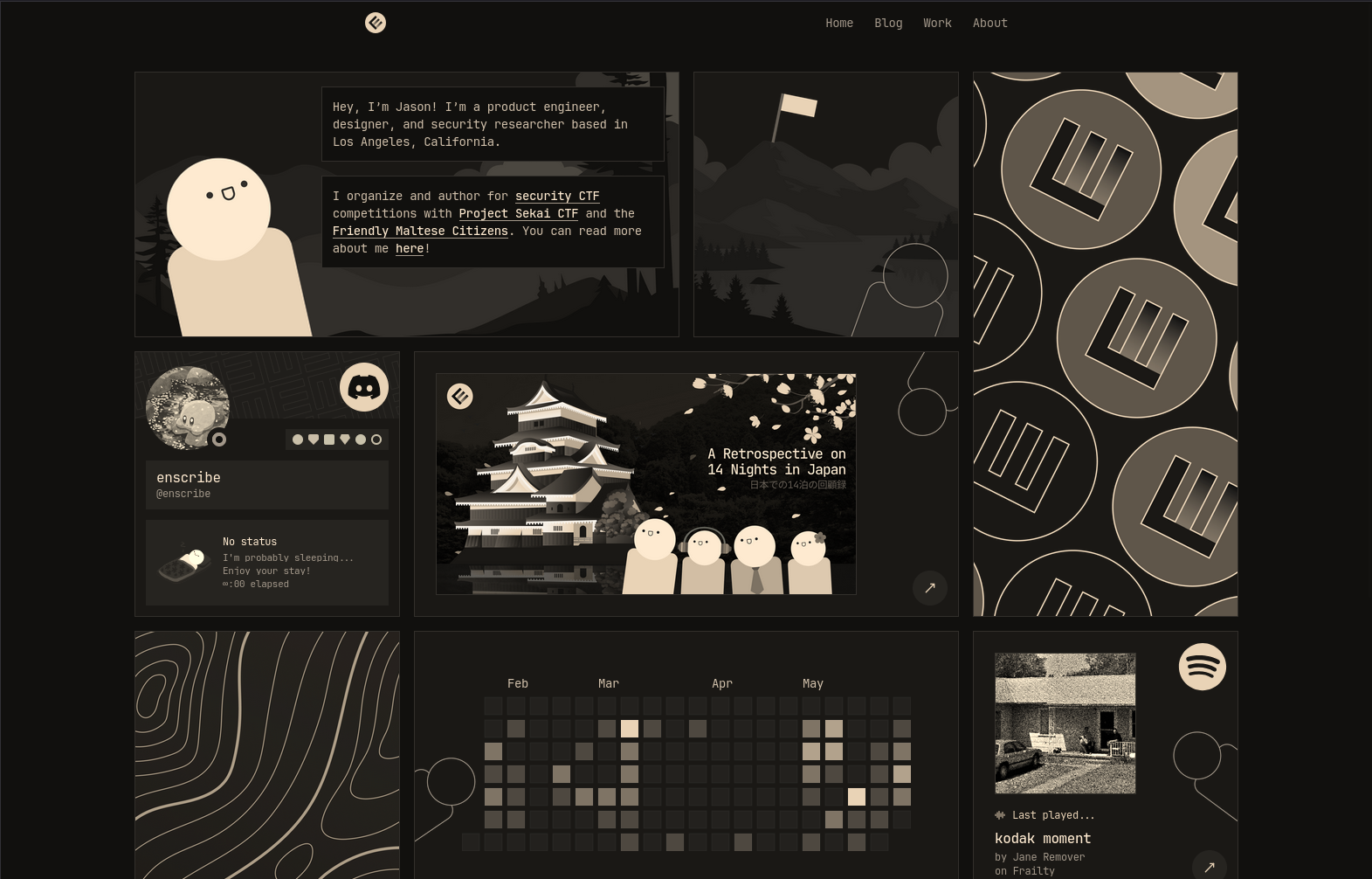
I’m excited that many people I know are thinking of starting a blog or a podcast. I hope that through breaking down assumptions about how hard owning your work can be, they can keep more of the revenue they bring in. Sustaining an independent publication is tough work even for the best writers. After putting in effort to write something worth reading, or recording something worth listening to, why should you give over that value? While stressful at first, being able to change your font whenever you like, is a great feeling.
There was a brief moment when Instagram/Threads was considering fully federating with other platforms like Mastodon and Pixelfed, however that dream died like most Meta projects do. ↩︎